
Welcome to the Mathematical World!
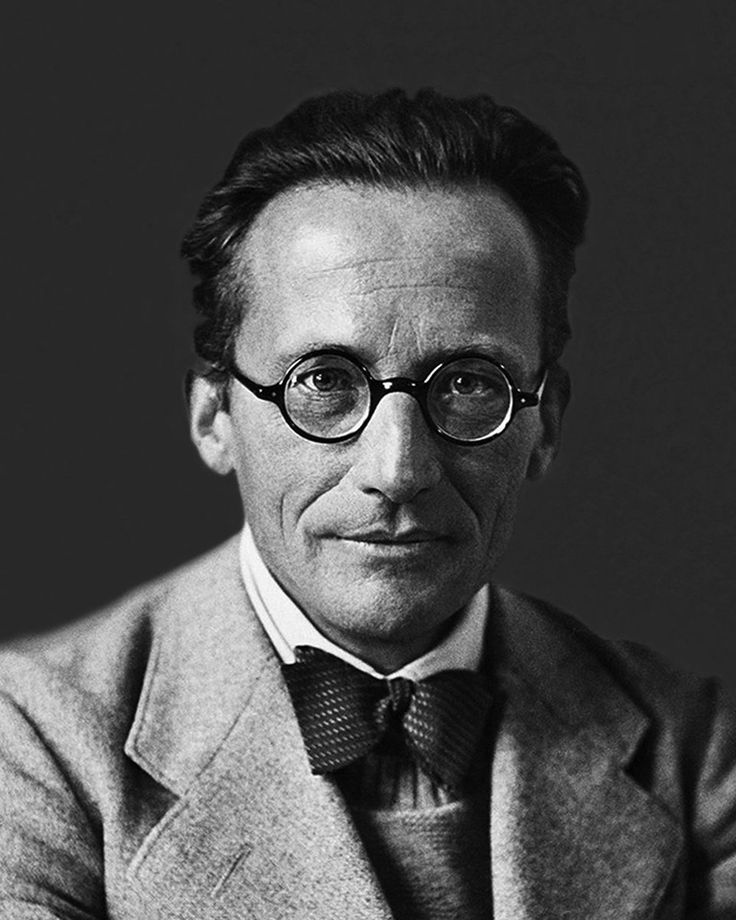
Erwin Schrödinger
Pioneer of Wave Mechanics
Erwin Schrödinger (1887–1961) was an Austrian theoretical physicist who made foundational contributions to quantum mechanics. Born in Vienna, Austria-Hungary, he is best known for developing wave mechanics and formulating the Schrödinger equation, which describes how the quantum state of a physical system changes over time.
Early Life and Education
Schrödinger studied physics at the University of Vienna, where he displayed exceptional talent in mathematics and theoretical physics. By his mid-twenties, he had already begun exploring the mysteries of atomic structure, which led him to the rapidly developing field of quantum theory.
Wave Mechanics and Schrödinger Equation
In 1926, Schrödinger formulated the Schrödinger equation, a partial differential equation describing the time evolution of a particle’s wave function \( \psi \). For a single particle in a potential \( V(\mathbf{r}, t) \), the equation is:
\[ i \hbar \frac{\partial}{\partial t} \psi(\mathbf{r}, t) = \hat{H} \psi(\mathbf{r}, t) \]where \( \hat{H} \) is the Hamiltonian operator representing the total energy of the system, \( \hbar \) is the reduced Planck constant, and \( i \) is the imaginary unit. This equation allowed physicists to predict probabilities of finding particles in various states, replacing classical deterministic trajectories with quantum probability distributions.
Schrödinger’s Cat and Philosophical Contributions
Schrödinger also explored the philosophical implications of quantum mechanics. In 1935, he proposed the famous Schrödinger’s cat thought experiment, illustrating the paradox of quantum superposition and measurement. The scenario describes a cat that is simultaneously alive and dead until observed, highlighting conceptual challenges in interpreting quantum theory.
Other Contributions
Beyond wave mechanics, Schrödinger contributed to:
- Statistical mechanics
- Color theory and theoretical biology
- The study of quantum entanglement and coherence
He also wrote the influential book What Is Life? (1944), exploring the physical basis of living cells, which inspired molecular biology and scientists like James Watson and Francis Crick.
Legacy
Schrödinger’s work earned him the Nobel Prize in Physics in 1933, shared with Paul Dirac, for the creation of wave mechanics. His wave equation remains a central tool in quantum physics, chemistry, and materials science. Schrödinger’s blend of mathematical rigor and philosophical insight left an enduring impact on both science and the broader understanding of reality.

All rights reserved by the Mathematical Unity
Contact: +8801400044645
Email: mathematicalhorse1453@gmail.com
Our Discord Server: Mathematical Unity [Ulus Riyadiyat]